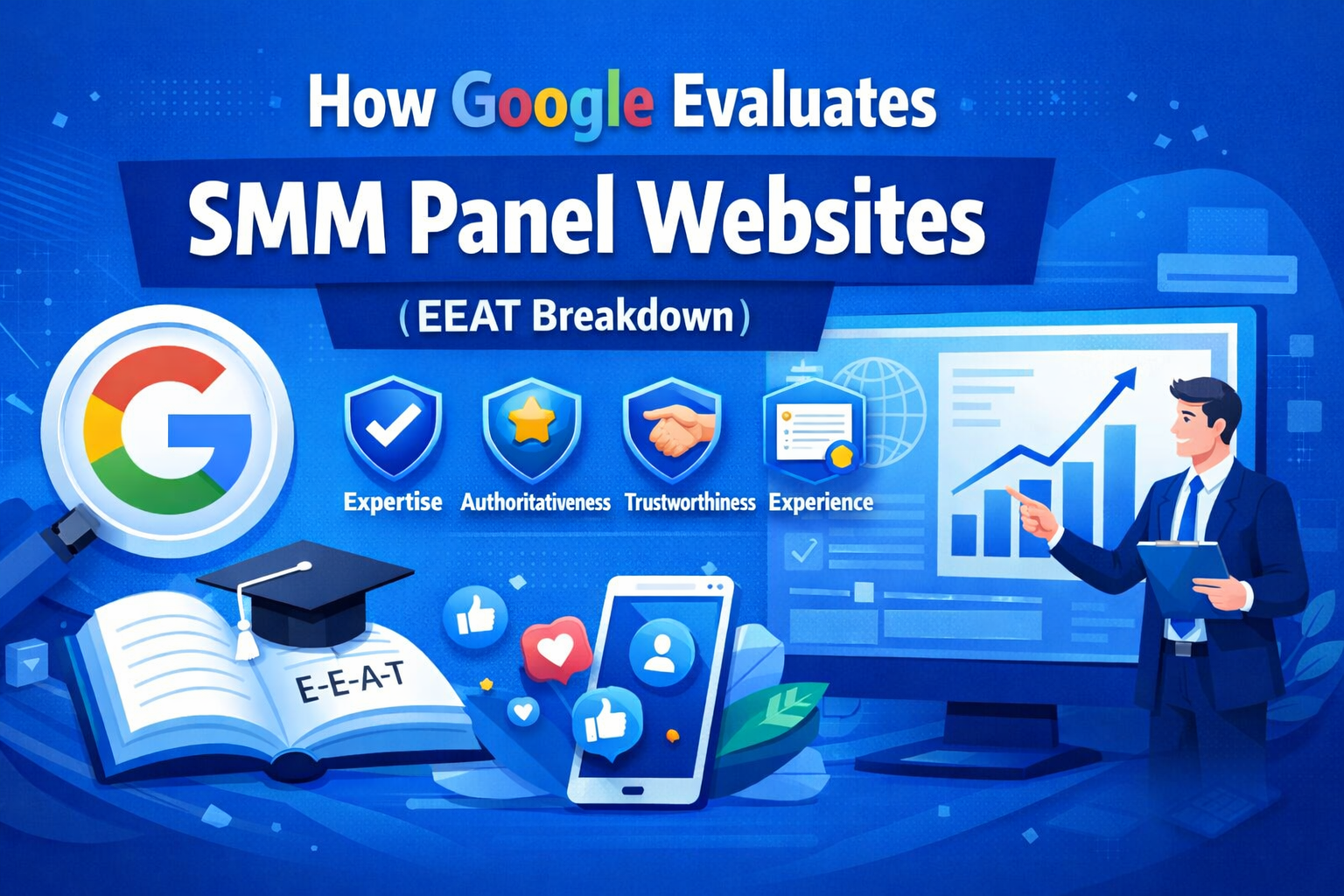
How Google Evaluates SMM Panel Websites (EEAT Breakdown)

How Google Evaluates SMM Panel Websites (EEAT Breakdown)

How Google Evaluates SMM Panel Websites (EEAT Breakdown)

Written for SMM panel owners, resellers, and agencies who actually care about ranking & long-term trust.

Here’s the thing nobody wants to admit: Google doesn’t trust SMM panel sites. Not because you’re a bad operator, but because the whole business model screams “sketchy” to an algorithm that’s designed to protect users from bad information.

Think about it from Google’s perspective. You’re selling followers. Platforms don’t want users buying followers. Drops happen. Refund fights happen. Accounts get flagged. And in most cases, you’re not even the original provider—you’re reselling from a backend. To Google’s system, that looks like: “This site might be helping people do something the platforms themselves discourage.”

That’s where EEAT becomes your real problem.

If you’re serious about ranking an SMM panel website, you need to understand how Google reads your credibility. It’s not random, it’s not emotional, and it’s not personal. It’s just strict. Once you see exactly where panel sites usually look weak, the path to fixing it becomes much clearer.

What EEAT Actually Is (And Why It’s Become Everything)

Around 2022, Google started talking openly about E‑A‑T. Then they added Experience and turned it into EEAT. That’s Experience, Expertise, Authoritativeness, and Trustworthiness.

The reason they doubled down on it is simple: the internet started filling up with garbage content. AI rewrites. Thin affiliate pages. Reseller sites with zero original insight. So Google needed a stronger filter for “Who actually knows what they’re talking about?”

Here’s what each part means in your world:

Experience

Experience means you’ve actually done this, not just rewritten someone else’s blog post. In SMM terms: you’ve run campaigns, tested providers, handled drops, dealt with client freak‑outs, and seen what happens to accounts months after a purchase.

On a website, Experience shows up as real case studies, screenshots, campaign breakdowns, and honest “this worked / this failed” stories.

Expertise

Expertise is knowing the “why,” not just the “what.”

“Buy followers to grow your account” is not expertise. Everyone says that.

Expertise sounds more like: “Buying followers works best when you combine it with consistent posting, because the algorithm weighs engagement velocity heavily. When drops kick in after 30 days, here’s what we’ve seen with different niches and account ages.”

Authoritativeness

Authoritativeness is whether other people treat you like you know what you’re doing. Do real sites link to you? Do marketers mention you? Do people search for your brand name, not just “cheap SMM panel”?

Trustworthiness

Trustworthiness is the big one for SMM panels. Are you transparent about how things work? Do you hide behind generic “Admin” or do you have real people and policies on the site? Do you admit the risks? Or do you pretend your services are magical and risk‑free?

Google uses EEAT to decide if your page deserves to be in the results at all. It’s not the only ranking factor, but in an industry like ours—where trust is already low—it’s the deciding factor between page 1 and page 5.

The Authority Problem (Why Your Competitors Are Ahead)

Let’s be blunt: a new SMM panel site starts with almost zero authority. In Google’s eyes, you’re just “another reseller” until you prove otherwise.

Backlinks: the hardest part for panels

Authority mainly comes from backlinks and reputation. And this is where panels have it rough. Big marketing or business sites don’t like linking to SMM panels, because it can look like they’re endorsing ToS‑gray services.

No links = no authority. No authority = no rankings.

The way around this is not spamming comments or buying junk links. It’s creating content that’s actually worth linking to: real studies, data breakdowns, industry‑level guides. That’s where a lot of bigger panels have started to move.

The reseller trap

Most panels don’t own the actual delivery. You’re plugging into APIs and providers. Google picks that up pretty quickly—especially when your site looks identical to 100 other panels with the same service list.

From an EEAT angle, that weakens your Expertise and Authoritativeness. You’re not leading the industry; you’re just another doorway to someone else’s service.

The panels that rank better behave differently. They don’t just “list services.” They publish breakdowns of how services perform, which providers are stable, what’s changed after algorithm updates, how retention looks over 30/60/90 days. In other words, they become the reference, not just the checkout page.

Brand searches as a ranking signal

Google pays attention to people searching for you by name. If people are typing “SMMFollowers” rather than just “buy followers,” that’s a strong trust signal.

That’s one reason an older, consistent panel like SMMFollowers has an advantage over a brand‑new “super‑cheap‑panel‑247” site. Time + real users + brand search volume adds up.

Expertise: You Can’t Fake It, But You Can Show It

The worst thing you can do right now is fill your blog with generic, AI‑sounding content about “How to grow your Instagram in 2025.” Google has seen that post 10,000 times already.

What works is showing real expertise.

Put real humans on your content

Every serious article should have an author with a face and a short bio: “Written by Aakash, 6+ years running SMM campaigns for agencies and resellers across 15+ countries.” That one line instantly improves EEAT.

If you’re publishing on your own panel blog, don’t hide behind “Team” and “Admin.” Put your experience on the page. Google pays attention to author information, and so do serious buyers.

Back up claims with your own data

Instead of saying “SMM panels work best for new accounts,” say:

“We tracked 200 new Instagram accounts using our services in the last 90 days. 87% saw improved engagement velocity in the first 30 days, with an average follower retention of 78% after 90 days. Here’s how it varied by niche and content frequency.”

That’s the kind of thing a quality‑rated page would say. And that’s the level you want to aim for if you actually want to outrank generic competitors.

Be honest about what doesn’t work

Strangely, “SMM panels can’t fix bad content” is one of the strongest trust statements you can make. It scares away the people looking for magic. But it attracts the serious ones who know panels are just one piece of the system.

Those are the people who turn into long‑term customers and real case studies.

Trust: Where Most SMM Panels Lose the Game

Users have plenty of reasons to mistrust SMM panels. They’ve been burned by drops, fake followers, unresponsive support, terrible dashboards, and “guarantees” that vanish the moment something goes wrong.

If your site copy sounds like you live in a fantasy world where nothing ever drops and every follower is “100% real & safe,” you’re instantly failing the trust test—for both users and Google.

Show you’re a real business

Your panel should have:

  • Clear company information and some context on who runs it
  • A proper contact page with realistic response times
  • Visible Terms, Privacy Policy, and Refund/Refill policy
  • Secure payment options (Stripe, PayPal, reliable crypto gateways, etc.)

People are already nervous about buying followers. If your site also looks shady from a payments or transparency perspective, they bounce. High bounce + no engagement = bad signal for Google.

Address the ugly parts directly

If you want to be seen as trustworthy, you have to say what most panels won’t say:

  • Followers can drop after a few weeks.
  • Retention depends a lot on account age, niche, and posting activity.
  • Panels help with social proof, not with compensating for terrible content.

Good operators explain this clearly. You can even link to deeper content—for example, a case study like this Instagram growth case study from SMMFollowers breaks down what actually happened, not just what was promised.

What Gets You Penalized (And How to Avoid It)

Google hits sites in two main ways: algorithmic drops (the system detects issues and pushes you down) and manual actions (a human reviewer looks at your site and decides you’re breaking rules).

Misleading or overhyped promises

If your homepage screams “Guaranteed 10,000 real followers in 30 days” but you’re mostly delivering low‑quality accounts, you’re playing a dangerous game. Even if Google doesn’t read the nuance, users will. They bounce, complain, and leave negative traces all over the web. That hurts you in the long run.

The more mature version is: “Most of our clients see 5,000–15,000 followers in 30 days depending on niche, account age, and content quality.” That’s the style that stays under the radar and matches reality.

Lazy AI content

Google is now actively tracking low‑value, generic AI content. If your entire blog is made up of stuff that reads like a template with swapped keywords, don’t expect it to rank.

AI is fine as a drafting tool. But you have to inject your own experience into it. Real numbers, real war stories, real examples. Otherwise, it’s just blog filler.

Spammy links and junk SEO

Buying links from random “top SMM panel” lists, link farms, and low‑quality blogs might give you a short bump, but it’s a long‑term risk. Too many junk links, and your site starts to look like part of a spam network.

It’s much better to have 10–15 strong, relevant links than 200 garbage ones.

Terrible performance and UX

If your panel takes 5 seconds to load on mobile, your SEO is already handicapped. Core Web Vitals are a real thing. Speed and usability matter in 2025, especially on mobile‑heavy industries like SMM.

The Real Limits of What Panels Do (And Don’t)

Let’s talk post‑purchase behavior and what actually happens after someone buys from you.

Scenario one: they buy 1,000 decent‑quality followers for an account that’s already posting decent content. The count jumps. Some of the new followers like and comment. The account looks more alive. The algorithm gives it a bit more reach, and with good content, organic growth starts picking up.

Scenario two: they buy 1,000 fake followers for a dead account with no content. The count jumps… and then nothing. No new content, no engagement. Within a few weeks, drops kick in and the account looks worse than before.

Same “panel,” completely different outcome. The difference is what happens AFTER the order, not the order itself.

What SMM panels cannot fix

  • They cannot make bad content perform like good content.
  • They cannot magically remove account flags or shadow bans.
  • They cannot transform random followers into buyers.
  • They cannot replace a real strategy with a one‑time boost.

Where SMM panels actually shine

  • New accounts: Creating social proof so people don’t dismiss the brand at first glance.
  • Time‑sensitive launches: Making the profile look active before a campaign or PR push.
  • Agency workflows: Helping agencies onboard multiple new accounts faster, then layering real strategy on top.
  • Reactivating dormant accounts: Using engagement services to wake up old audiences, when the base was real to begin with.

Used in those situations, panels are a tool. Used as a full “strategy,” they’re a trap.

The Metrics Nobody Explains: Drops, Velocity, and Engagement

If you’ve been in this game long enough, you’ve seen it: the “why am I losing followers?” ticket that comes in 30 days after a big order.

Most of the time, it’s not that the provider “scammed” them. It’s the way they used the service.

An account that jumps from 500 to 5,500 followers overnight looks suspicious—both to real users and to the platform. Especially if there’s no content surge alongside it.

Account age plays a big role. A 2‑year‑old account can survive sudden growth more gracefully than a 2‑week‑old one. There’s more history, more behavioral data, more context. The younger the account, the more “unnatural” a giant spike looks.

Growth velocity (how fast followers are gained) and engagement ratio (how many people actually interact with content) are the real levers. Slow, steady growth with healthy engagement looks organic. Sudden spikes with flat engagement look artificial.

And that’s where most customers shoot themselves in the foot: they buy a big package and then post nothing for 10 days. Of course drops happen. Of course things look fake.

The smart ones sync their purchase with a content plan—strong posts, Reels, TikToks, Shorts, whatever they’re using. The panel adds social proof, the content gives the algorithm something real to push.

What SMM Panels Cannot Fix (Hard Truths You Should Actually Say)

From Google’s EEAT perspective, the fastest way to lose trust is to promise things your service cannot deliver, no matter how good your provider is.

  • Panels can’t give you 10,000 followers who all care deeply about your product.
  • Panels can’t make TikTok or Instagram suddenly “love” your low‑effort content.
  • Panels can’t protect you from platform‑level risk if you’re already flagged.
  • Panels can’t give you long‑term growth if you never fix your offer, content, or positioning.

The strongest operators say this clearly on their site. They define where panels fit inside a full strategy, instead of positioning them as the whole plan.

If you want a deeper strategy view, look at flow‑style guides like your 2026 strategy breakdowns. A good example: a piece like this social media strategy flowchart shows panels as part of the system, not the hero.

FAQ: What SMM Panel Operators Actually Ask

Does having a big Instagram following help my SMM panel website rank on Google?

Directly, no. Google doesn’t see your Instagram follower count. Indirectly, maybe. If that following sends real traffic to your site (through bio links, Stories, ads, etc.), and users stick around, that sends good signals to Google. The ranking boost comes from traffic and behavior, not the follower number itself.

Can I use AI to write my blog content and still rank?

You can use AI, but you can’t rely on AI alone. If you just paste output and hit publish, you’re competing with thousands of identical posts. If you use AI as a draft and then inject your experience—real examples, data, and warnings—you’re in a totally different league. Google is okay with assisted content; it’s not okay with soulless, low‑value content.

How long does it take for a new SMM panel site to build EEAT?

Realistically 6–24 months. If you publish deep content, show real results, get mentioned on a few decent sites, and don’t cut corners, you can see traction in under a year. If you do nothing but set up a panel and wait, you’ll stay invisible.

What’s the single biggest EEAT mistake SMM panel sites make?

Making huge claims without evidence. “Most trusted panel,” “#1 fastest panel,” “100% real & safe” with no proof, no data, and no third‑party validation. From a Google and user perspective, that screams low trust.

Should I hide that I’m a reseller?

No. Be upfront. You don’t need to reveal your providers, but you can absolutely say you work with multiple premium delivery networks and actively test them. That’s more believable than pretending you created every service from scratch.

Can an SMM panel site rank without backlinks?

On very small keywords, maybe. On competitive ones, almost never. Backlinks are still one of the strongest authority signals. Focus on getting a handful of quality links from relevant sites instead of chasing hundreds of random ones.

Practical next step

If you’re running an SMM panel or reselling services and you actually care about long‑term rankings, treat EEAT like part of your product. Build proof, show your face, share what really happens after customers buy, and be honest about limits.

When you’re ready to study how other operators position themselves and structure offers, spend 15–20 minutes exploring a few reference points like live service pages and real‑world case studies. Take the parts that align with your model, leave what doesn’t, and build something that can survive both Google updates and client expectations.